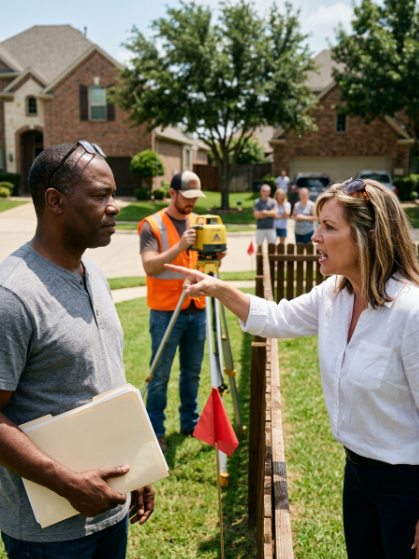
The surveyor crouched at the corner of Sandra’s pool deck and checked his instrument twice before he said anything.
“This isn’t really a property-line dispute,” he said. “Not the way it was filed.”
Sandra crossed her arms. “My complaint is about his fence.”
“I understand. But while I’m out here, I’m required to flag what I find.” He nodded at the three flags marching across her lawn. “Ma’am, your pool and about half of your patio are sitting on a public drainage easement. City land. Roughly eight feet of it.”
For a second, nobody on that cul-de-sac said a word.
Then the folding chairs full of Sandra’s friends got very interesting to their occupants.
“That’s impossible,” Sandra said. “That pool was permitted.”
“The pool may have been. The setback wasn’t honored.” He held up his tablet, the readout glowing. “And your fence complaint is what opened the survey that found it. You filed the request. The county had to pull the whole plat.”
I almost felt sorry for her.
Almost.
Because for two years this woman had stood up at every meeting and called me a thief. She’d mailed our neighbors a flyer. She’d told the new family on the corner to keep an eye on the man at number twelve.
I’d kept my mouth shut and kept my paperwork.
Now her own lawsuit had turned around and bitten her.
“My fence?” I asked the surveyor quietly.
He glanced at his notes. “Six inches inside your line. You’re fine. You could have built it taller.”
Sandra’s face did something complicated.
The county didn’t move fast, but it moved. Within a month she received the kind of letter she’d spent years sending other people. A notice. A deadline. An order to remove the encroaching structure from public land at her own expense, or face fines that grew by the day.
The pool she’d bragged about all summer had to be partially demolished and the deck rebuilt eight feet back. The contractor she hired told half the street what it cost. It was not a small number. Somewhere north of forty thousand dollars, by the time the concrete was hauled away.
Her lawsuit against me was dismissed before it ever reached a courtroom. My attorney sent one letter and that was the end of it.
But the part I didn’t expect came at the next HOA meeting.
I went, for once. I sat in the back.
A woman two streets over stood up first. She’d been fined eight hundred dollars for a wheelchair ramp she built for her father without “approval.” She’d been quietly furious for a year.
Then the man whose camper Sandra had reported four times. Then the couple she’d threatened over their vegetable garden. Then a widower who’d gotten a citation for the memorial rosebush on his own lawn.
One by one, people who’d been too scared to speak found out they weren’t alone.
You could feel the room change. Two years of swallowed anger, finally with somewhere to go.
By the end of the night, the board called a vote.
Sandra Voss was removed as president of the homeowners association.
She didn’t shout. She gathered her binder, the one with a photo of my fence on the cover, and she walked out into the parking lot alone.
I caught up to her by her car. I don’t fully know why.
“I’m not here to gloat,” I said. And I meant it. “I just wanted to say I hope the rest of your summer is quieter.”
She looked at me like she was searching for the trick in it.
There wasn’t one.
The new board kept the rules that made sense and threw out the ones that had only ever been about power. The fines stopped feeling like ambushes. People started leaving their garage doors open again, the way you do when you aren’t afraid of being watched.
My fence is still three inches from the line Sandra swore I’d crossed.
It never moved at all.
These days her old survey flags are long gone, and the grass has grown back green over the patch where the pool used to reach.
I water my lawn in the evenings now, and my neighbors wave when they pass. My daughter rides her bike up and down the cul-de-sac without anyone timing how long the chalk stays on the driveway.
Funny how a fence can show you exactly who your neighbors are.