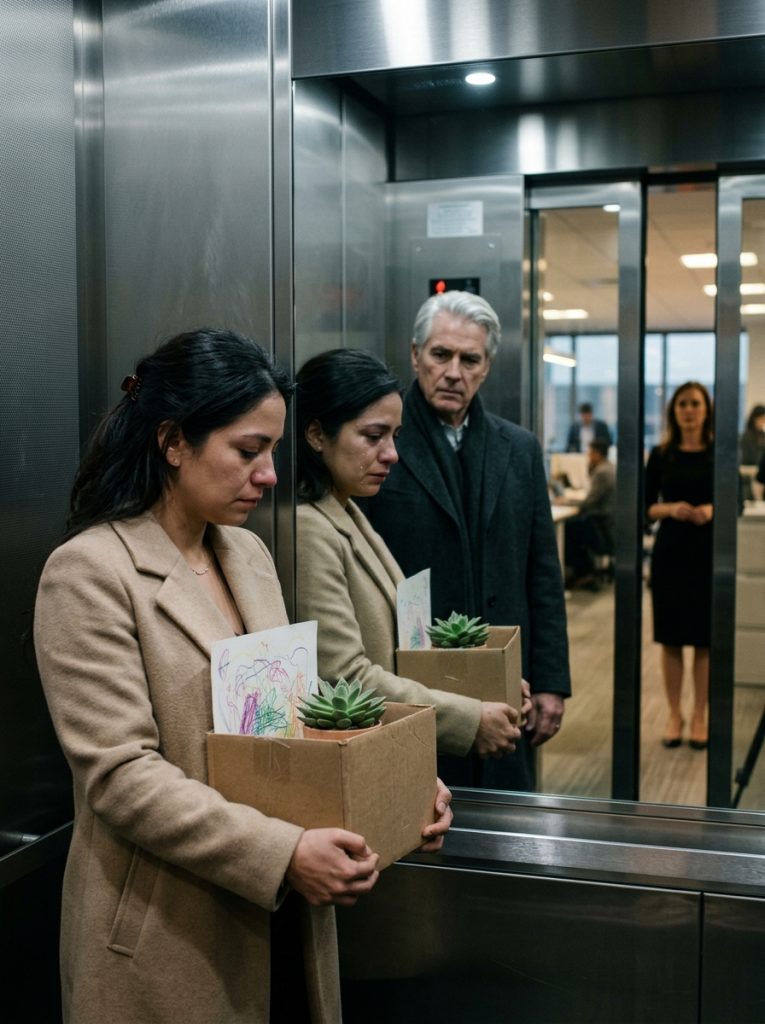
“Hold the doors. We’re going back.”
Six words, quiet, almost to himself. Then Arthur Penn reached past me and pressed twelve.
The elevator stopped sinking and began to climb.
“Sir,” I started, wiping my face fast, “I’m fine, I’m just leaving, I don’t want any trouble—”
“You’re not the one in trouble,” he said.
He looked at the box in my arms. The succulent. The coffee mug. And on top, Mateo’s crayon drawing — the two of us holding hands under a fat yellow sun, the tears I’d dripped on it still wet.
“Whose drawing is that?” he asked.
“My son’s. He’s six. He’s—” My voice wobbled. “He’s the reason I’m holding this box.”
“Tell me,” Penn said.
So I told him, in the time it takes an elevator to rise twelve floors. The sitter who canceled at 5 a.m. The school that didn’t open for hours. The choice between losing the job and leaving a six-year-old alone in a cold apartment. How I’d hidden him in the break room with crayons and a juice box and a whispered promise to be a little ghost. How Gail had found him and made it a spectacle.
The doors opened on twelve.
The whole floor was still buzzing about the woman who got walked out. Then they saw who was standing beside her, and the buzzing stopped.
Penn didn’t raise his voice. The dangerous ones never do.
“Where is the boy?” he asked.
“Break room,” I whispered.
He walked in there himself. And he found Mateo exactly where I’d left him — in the corner behind the potted plant, books squared in a neat little stack, so trained to be invisible that he’d stayed silent through his mother’s whole humiliation.
I watched a sixty-three-year-old man who runs a company fold himself down to the floor to sit at a six-year-old’s eye level.
“That’s a good fort,” Penn told him. “Can I see your drawings?”
Mateo, who barely speaks to strangers, showed him every page.
When Penn stood back up, his face had changed.
He asked for Gail. He asked, in front of the floor, who had authorized firing a single mother for finding childcare in a crisis, and whether anyone present had ever, even once, brought a kid to the office on a snow day.
Half the floor slowly raised their hands.
Then he asked HR to pull Gail’s history. It turned out I wasn’t the first. Gail — the owner’s niece, untouchable until that morning — had a pattern. The early-leave requests denied. The “performance issues” that always seemed to land on parents and caregivers. The complaints that quietly disappeared because of whose niece she was.
The thing about being the owner’s niece is that it works right up until the founder is standing on your floor with a crying woman’s box in his eyeline.
Gail was escorted out by the end of the day. Not me.
Penn didn’t stop at undoing one firing.
He stood on a chair in the middle of that open office — a man who did not need to stand on a chair to be heard — and he said that he had built this company believing that the people who show up exhausted and scared and still do the work are the ones worth keeping, and that no one in his building would ever again apologize for being a parent.
By the next week it was policy. Real policy, in writing. Emergency backup childcare, paid. A quiet family room near the break room with a door that locked and toys that weren’t hidden behind a plant. A standing rule that a sick kid or a canceled sitter was a reason to be helped, not fired.
They reinstated me with the title and the raise Gail had been blocking for a year. I almost said no. Pride is a stubborn thing. Then I looked at Mateo’s drawing and thought about backup childcare and a locked family room, and I said yes.
The succulent is back on my desk. So is the crayon sun.
Mateo comes by on snow days now. He has a beanbag in the family room and a standing high-five from the guy on the wall by reception, who turned out to be a real person who sits on the floor and looks at drawings.
People ask me sometimes if I’m angry about that morning — the long walk, the silent floor, the box.
I tell them the truth.
I spent the worst elevator ride of my life trying to hide my face from a mirror.
And the one person who saw it anyway was the only one in the building with the power to turn the whole thing around.