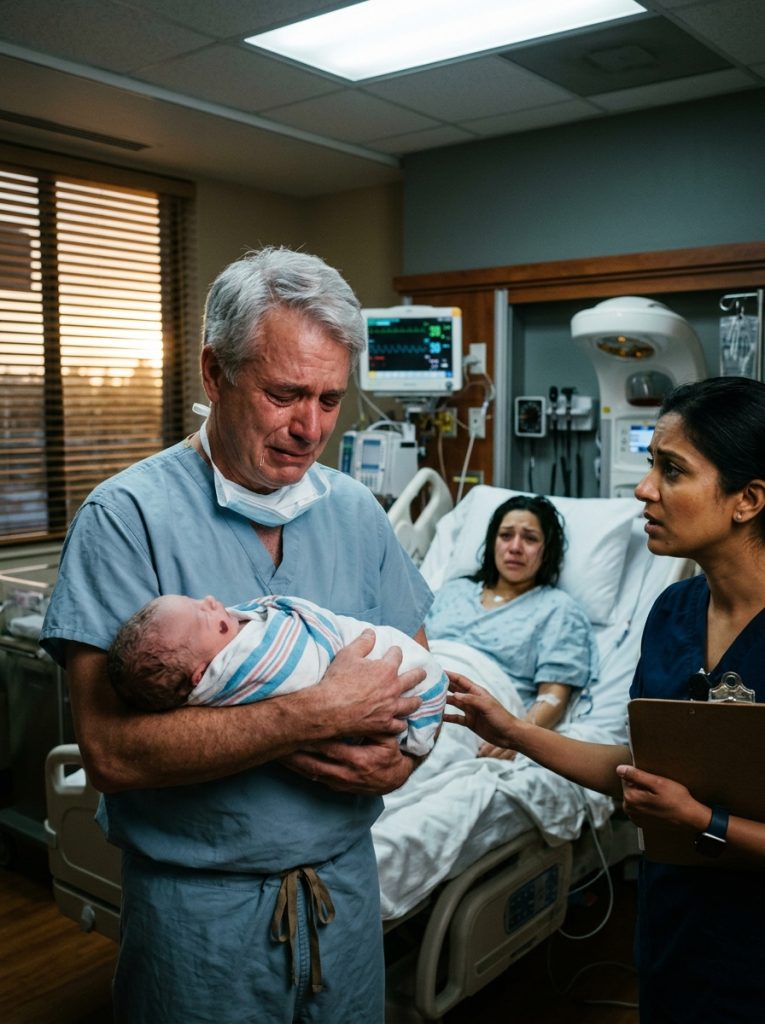
The nurse finally got the words out of him.
“Dr. Whitfield. You need to step out, or you need to tell us what’s happening. You’re scaring the mother.”
He looked at me then — really looked — and he handed my son into Priya’s arms with the care of a man returning something that wasn’t his. He wiped his face with the back of his wrist, took a breath that shook on the way down, and said the strangest thing.
“What is the father’s name?”
“He’s not in the picture,” I said. The fear was making me sharp. “Why?”
“Please.” His voice cracked. “His name.”
“Marcus,” I said. “Marcus Whitfield.”
And the doctor — Dr. Samuel Whitfield — closed his eyes like the name was a wave going over his head.
“That’s my son,” he whispered. “Marcus is my son.”
The room tilted.
He sat down heavily on the rolling stool, this composed older man in pale blue scrubs, and he told me, in pieces, between the monitors beeping and my own heart hammering, the thing I’d spent seven months unable to understand.
“Every Whitfield man for four generations has been born with that mark,” he said, nodding at the little comma-shaped birthmark below my son’s collarbone. “My father had it. I have it. Marcus has it. I knew the second I saw it. I’d know it anywhere.” He pressed his fingers to his mouth. “I haven’t seen my son in seven years.”
I learned the rest over the next hour, while they monitored the baby and I refused to let them move me to recovery until I understood.
Marcus had grown up here, in Portland, the only child of a doctor who loved his work a little too much and a mother who died young. When Marcus was twenty-four, money went missing from the family medical practice — a lot of it, over months. The evidence pointed at Marcus. There’d been a terrible night, accusations, a door slammed so hard the glass cracked. Samuel told him to leave and not come back until he could look him in the eye.
Marcus left. He never came back. And Samuel, too proud and too wounded, never went looking.
“I was wrong,” Samuel said. He wasn’t talking to me anymore, not really. “The office manager confessed two years later. Embezzlement. She’d structured it to land on Marcus because he was young and angry and easy to blame. By the time I knew, he was gone. No address. No phone. I’d burned it all down myself.”
And suddenly the worst night of my life rearranged itself in front of me.
The night I told Marcus I was pregnant, he didn’t get cold because he didn’t care. He got quiet. He picked up his keys and said I can’t, and I’d spent seven months believing that meant I can’t be bothered.
But I’d met a man who carried something he never explained. Who flinched at the word family. Who once told me, on a good night, that he’d make a terrible father because he came from a man who threw his own son away — and then refused to say another word about it.
He didn’t leave because he didn’t want our son.
He left because he believed, in his bones, that Whitfield fathers ruin their children, and he was terrified of proving himself right.
It was the oldest, saddest misunderstanding in his whole family, handed down like the birthmark — and it had cost all of us seven months and very nearly everything.
A nurse, it turned out, had recognized the surname on my chart and made a quiet call. At a little past six that evening, Marcus arrived in the parking lot of Mercy West.
I didn’t see the reunion. Samuel told me about it later.
He met his son at the hospital entrance, under the glass doors, and Marcus stopped ten feet away like the ground might not hold him. Two grown men who’d spent seven years being wrong about each other.
“I’m not going to pretend it’s fixed,” Samuel told him. “You don’t get to walk in there and hold that baby because you share my blood. That’s not how it works anymore.” He’d put a hand on his son’s shoulder. “But you came. When the call went out, you came. That’s the first thing either of us has done right in seven years. So we start there. Slowly. You prove it to her, not to me.”
Marcus came up to the maternity floor an hour later. He stood in the doorway of my room exactly the way his father had described him standing in the parking lot — like he wasn’t sure he was allowed.
“Hi,” he said.
We have a long way to go, Marcus and I. Seven months is a real wound, and you don’t paper over it because a doctor cried. He’s earning it now — diapers at 3 a.m., the pediatrician appointments, the small unglamorous proofs. I’m watching. Carefully.
My son’s last name is still Reyes. I told both of them that, gently, the first week. Reyes is the name of the woman who did the double shifts and painted the secondhand crib. He can grow into the rest if the rest grows into him.
Samuel comes by twice a week. He’s not the absent father anymore and he’s not quite forgiven, either. He’s just the grandfather who held him first — who took one look at a comma-shaped birthmark and wept, because in that single second he understood everything he’d thrown away, and everything he might, if he was very lucky and very patient, be allowed to earn back.
The other night he sat in the corner chair with the baby asleep on his chest and said, very quietly, “Four generations. And not one of us knew what the mark was really for.”
“What’s it for?” I asked.
He looked down at my son.
“To find our way back,” he said.