Daniel opened the envelope on the path, ten feet from the swing set, and I watched the color leave my ex-husband’s face.
I already knew what it said. I’d known for six weeks.
Inez had warned me, back in the prep meetings before my release, that the new DNA evidence did more than clear me. It pointed somewhere. The genetic material from the steering wheel and the airbag of the car that killed a man in 2017 — the car I supposedly drove — wasn’t mine. It never matched me. That’s what got my conviction vacated.
But it matched someone.
It matched Carter Marquez. Daniel’s older brother. The man who’d had dinner at our family’s table every Sunday for eight years while I sat in a cell for what he did.
“This is — this isn’t possible,” Daniel said. The paper shook in his hand.
“It’s possible,” I said. “It’s a lab report. They don’t lie the way people do.”
I want to tell you I felt triumph. I’d rehearsed triumph for eight years. I’d pictured marching into that family’s house and watching them choke on it.
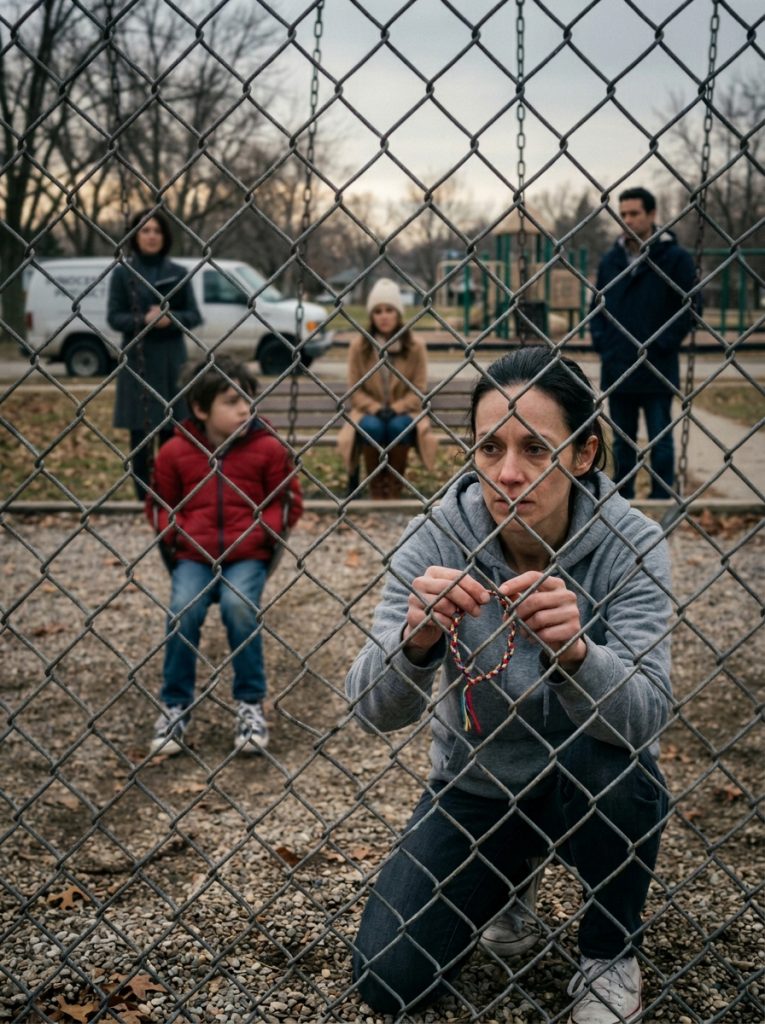
But I was kneeling on the cold side of a chain-link fence, and on the other side my son was on a swing in a red coat, looking at me like I was a stranger handing him a bracelet, and triumph turned out to be the smallest, least important thing in the entire park.
“Carter was driving,” I said quietly. “You knew there were questions. Your family closed ranks. It was easier to let the wife take it than the son who’d already had two DUIs. I’ve had eight years to do that math, Daniel. I’m not here about Carter.”
He looked at me, stunned. “Then why are you—”
“Because of him.” I nodded at Mateo. “That’s the only reason I’m standing in this park.”
Here’s the thing I had decided, somewhere around year six, lying on a prison bunk: I could come out of there and spend my freedom burning that family to the ground. Carter would face charges either way — Inez had already sent the report to the state’s attorney; that machine was moving and didn’t need my rage to fuel it. The truth was going to exonerate me whether I screamed it or not.
Or I could spend my freedom on the one thing prison had actually stolen that I might still get back.
My son was three weeks old when they took me. He’s eight now. He calls Gabrielle “Mom” and there’s a real love there, and I am not going to pretend that didn’t gut me, because it did. But Gabrielle, to her enormous credit, was the one who’d written to me in year five. Just once. To tell me Mateo was okay. To send a school photo. She didn’t have to. Most people in her position wouldn’t have.
So I knelt at the fence, and I threaded the little braided bracelet through the diamonds in the mesh, and I didn’t ask Mateo for anything. Not a hug. Not recognition. Not the word he’d never had a reason to say to me.
“I made this for you,” I said. “You don’t have to wear it. You don’t have to know me. I just wanted you to have something I made with my hands while I was thinking about you. Which was every single day.”
He looked at the bracelet for a long moment.
Then he reached through the fence and took it. He didn’t run to me. He didn’t call me anything. He just closed his small fist around it and looked at me with a kind of careful curiosity, the way kids look at something they’ve been told about but never seen.
“Gabrielle says I had another mom,” he said. “Before.”
“You did,” I said. My voice barely worked. “You do. I’m not going anywhere this time. But I’m okay being a stranger for as long as you need me to be one. We’ve got time now. That’s the part that’s different.”
He nodded, very seriously, the way eight-year-olds do when the world hands them something too big. Then he tied the bracelet around his own wrist, badly, double-knotted, and went back to swinging.
That was it. That was the whole reunion. No music. No running into arms.
It was the most important thing that has ever happened to me.
Carter was arrested three weeks later. The trust the family had built around protecting him collapsed quietly, the way these things do once a lab report exists — first a lawyer, then a plea conversation, then a sentence that will not give me back eight years but will at least stop the lie from standing. Daniel, to my surprise, did not fight the truth once it was in his hand. I think some part of him had been waiting a long time to put it down.
I got a small settlement from the state for the wrongful conviction. It is not enough. It is never enough. But it bought a little apartment twenty minutes from Mateo’s school, and a court agreed to a slow, supervised schedule of visits that gets a little less supervised each season.
Last month he wore the bracelet to one of them. Still double-knotted. Fraying now.
“I didn’t take it off,” he told me, like a confession.
I didn’t cry until I got to the car.
People think exoneration is the happy ending. The moment the gate opens and the truth wins. It isn’t. The truth winning just stops the bleeding. What you do after — that’s the part nobody photographs.
I’m not Mateo’s mom yet. Maybe I never get to be, the whole way. But I’m the woman at the fence who made him something with her hands.
And every time he shows up still wearing it, I understand a little more that this was never going to be a reunion.
It was always going to be a beginning.