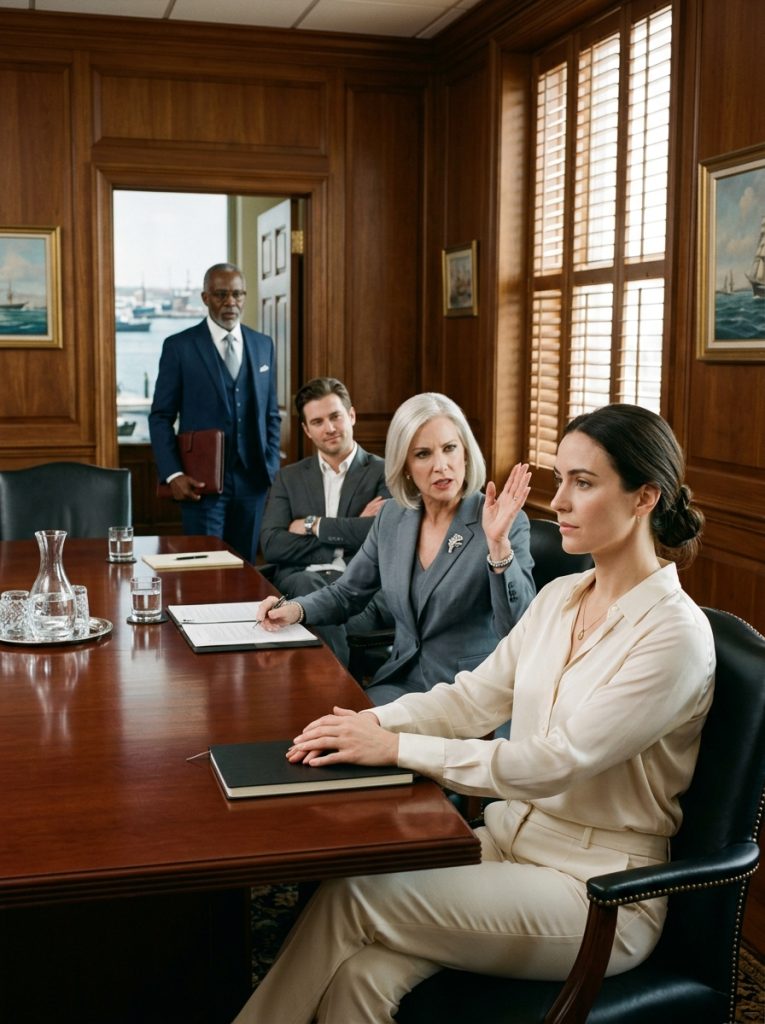
I didn’t say one word for the first ninety minutes of my father’s estate meeting. I have learned that silence makes people show you exactly who they are.
We were in a conference room high over the Charleston harbor, the kind with plantation shutters and oil paintings of ships. My stepmother Cynthia ran it like a CEO. Her son Grant lounged beside her, checking a watch worth more than the car I drove there in.
They read me out of my own father’s life, line by line.
The house on Tradd Street, where I grew up — “more appropriate for Cynthia to maintain.” The accounts — “consolidated for simplicity.” The 1962 wooden sailboat my dad and I sanded and varnished every summer of my childhood, the boat he taught me to read the wind on — “gifted to Grant, who’ll actually get use out of it.”
I wrote it all down in a plain notebook. Calm. Quiet.
Cynthia mistook that for surrender. She capped her pen and gave me the smile she saves for waitresses and valets.
“June, honey. I know this is hard. But you need to be realistic. Challenging an estate of this size takes attorneys — serious ones, the kind that bill more in an hour than you make in a month. You can’t afford that. So let’s not drag your father’s memory through an ugly fight you’ll lose.”
Grant laughed. Out loud.
Here’s what they didn’t know.
My mother — my real mother, who died when I was eleven, who Cynthia liked to pretend never existed — came from money. Not loud money. Quiet, old, careful money. And before she passed, when she knew she was sick, she did one last fiercely practical thing.
She set up a trust for me. And she put a law firm on retainer to protect it. Not when I turned eighteen. Not when I “needed” it.
The week I was born.
For thirty-three years, a firm has been quietly watching over what my mother left me, waiting for the day someone tried to take it.
So in that conference room, while Cynthia smiled, I picked up my phone under the table and texted the number I’ve had memorized since I was a teenager. Three words: “It’s time. Come.”
Then I folded my hands and said the first thing I’d said all morning. “Let’s wait two minutes.”
Cynthia blinked. “Excuse me?”
At minute two, the door opened.
Walter Osei walked in like weather. Navy three-piece suit, silver glasses, an oxblood portfolio under his arm. He’s the senior partner. He held me as a newborn at my christening, though I only know that from photographs. The estate lawyer Cynthia had hired half-rose from his chair and went gray, because he knew exactly who Walter was, and exactly what it meant that he was here.
Walter set the portfolio down in front of me. “Ms. Hadley. My apologies — traffic from the airport.”
“Who,” Cynthia said, “are you?”
“Walter Osei. Senior partner. My firm has represented this family on retainer for thirty-three years.” He looked at her over his glasses with the patience of a man who has buried sharper opponents. “Specifically, the trust established by the first Mrs. Hadley for her daughter, June. Since the week of her birth.”
Then he opened the portfolio, and what was clipped to the first page took the air out of the room.
It was the deed to the house on Tradd Street. And it had never belonged to my father to give away.
“The Tradd Street property,” Walter said, “was purchased with funds from June’s mother’s family and titled into June’s trust in 1992. Mr. Hadley held a life tenancy — a right to live there until his death. He could not bequeath it. It reverts, in full, to June. Today.”
Cynthia’s mouth opened and nothing came out.
“As for the consolidated accounts,” Walter continued, turning pages, “two of the three contain commingled trust assets. We’ll be requesting a full accounting. And the amendment you filed last month, Mrs. Hadley — the one moving the sailboat and the liquid accounts to your son — was witnessed and notarized on a date when Mr. Hadley was, per his own medical records, in hospice and non-responsive.”
He let that sit.
“That’s not an inheritance question,” he said softly. “That’s a forgery question. And those are handled in a different building.”
Grant stopped laughing. He stopped doing anything. He just stared at his mother, and you could watch him understand, in real time, that she’d led him off a cliff.
Cynthia tried one last thing. The smile, wobbling now. “June. Sweetheart. We can keep this in the family. There’s no need for lawyers.”
I finally turned my notebook around so she could see the page. I hadn’t been taking notes on the estate. I’d been listing every lie she’d told in ninety minutes, timestamped, in my own hand. A contemporaneous record. Walter had taught me that phrase over the phone when I was nineteen.
“There’s every need for lawyers, Cynthia,” I said. “Mine just got here.”
I gave her until the end of the month to leave the house on Tradd Street. I let Grant keep his watch. I’m not a monster.
But the sailboat, I sailed out of the harbor myself the next Saturday, the way my dad taught me, reading the wind off the water.
My mother spent the last clear months of her life making sure that no one could ever tell her daughter she couldn’t afford to fight.
Turns out the most expensive thing in that room was the lawyer she hired before I could even hold up my own head.